 AI Briefing
Amagine3D: Hardware Enclosure Design Editable via Natural Language Requirements
amagine-ai/Amagine3D
About the project
By inputting only a product description, reference images, and key dimensions, the system automatically designs an enclosure and assembly structure tailored to the internal components. The generated designs can be exported as STEP, STL, and 3MF files, with Python and build123d source code preserved at every stage to enable subsequent modifications.
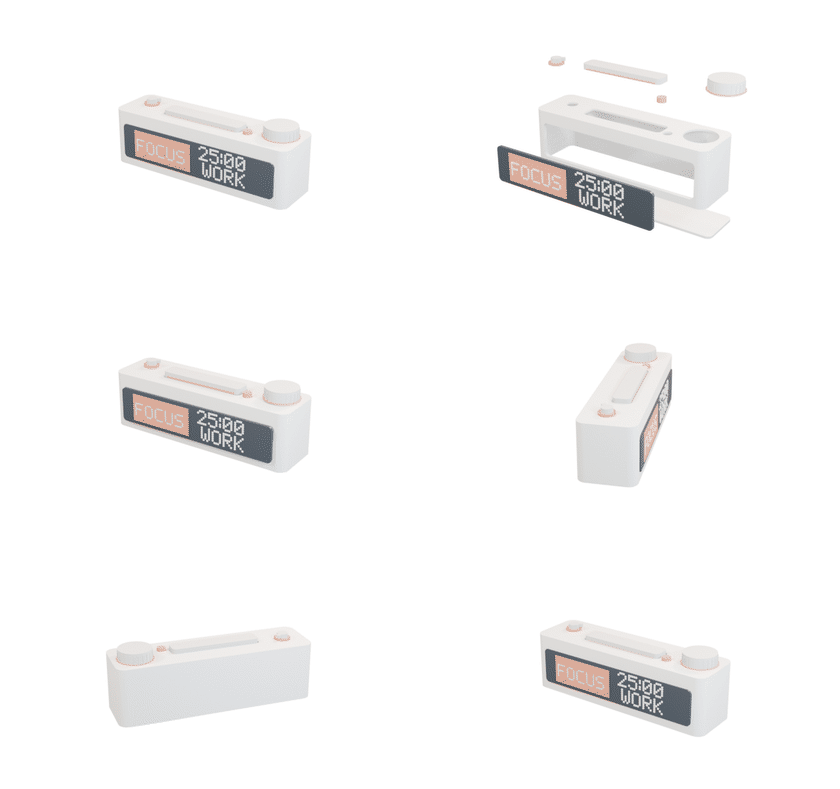
The design process begins with internal component placement, sequentially constructing mounts, interfaces, and thermal management structures. For rigid mechanisms such as hinges or slide covers, it verifies collision status and operating clearance, while for multi-part designs, it accounts for assembly gaps and printing tolerances.


The core is a 3D-native agent architecture. The agent builds actual models in a browser-based geometry runtime, checking part connectivity, interference, and motion paths in real time. It iteratively refines designs based on actual measurements rather than text-based judgments, committing only verified candidates as new versions.
Unlike existing CAD tools, it converts natural language requirements into a design brief, generates source code, and immediately reflects dimension adjustments made in the workbench back into the source. While currently focused on parametric CAD, it aims for extensibility to integrate various 3D input sources such as meshes, scans, and point clouds, along with manufacturing process data.
amagine-ai/Amagine3D
Amagine3D: From hardware requirements to editable 3D designs
Python
This introduction was generated automatically by AI. Check the original for the author's claims and context. Copyright belongs to the original author.
Our guide explains how the AI works. Report errors, attribution issues, or removal requests via Contact.