 AI Briefing
ruflo: 100-Agent Orchestration: Transplanting a Nervous System into Claude Code
ruvnet/ruflo
About the project
A Harness layer that runs Claude Code and Codex, enabling inter-agent collaboration and autonomous learning beyond simple code generation. While models write code, Ruflo provides tools, memory, loops, sandboxes, and control features to build an environment where agents can actually work. With a single `npx ruflo init`, it transplants a nervous system into Claude Code, allowing agents to self-organize, learn from tasks, and maintain memory across sessions.
It includes over 100 specialized agents covering various domains such as coding, testing, security, documentation, and architecture. The AgentDB vector memory with HNSW indexing demonstrates search performance approximately 1.9x faster than brute force at N=20k, and approximately 3.2–4.7x faster at N=5k. Additionally, 12 auto-trigger workers handle auditing, optimization, and test gap analysis in the background, with extensibility supported through 33 native plugins and 21 npm plugins.
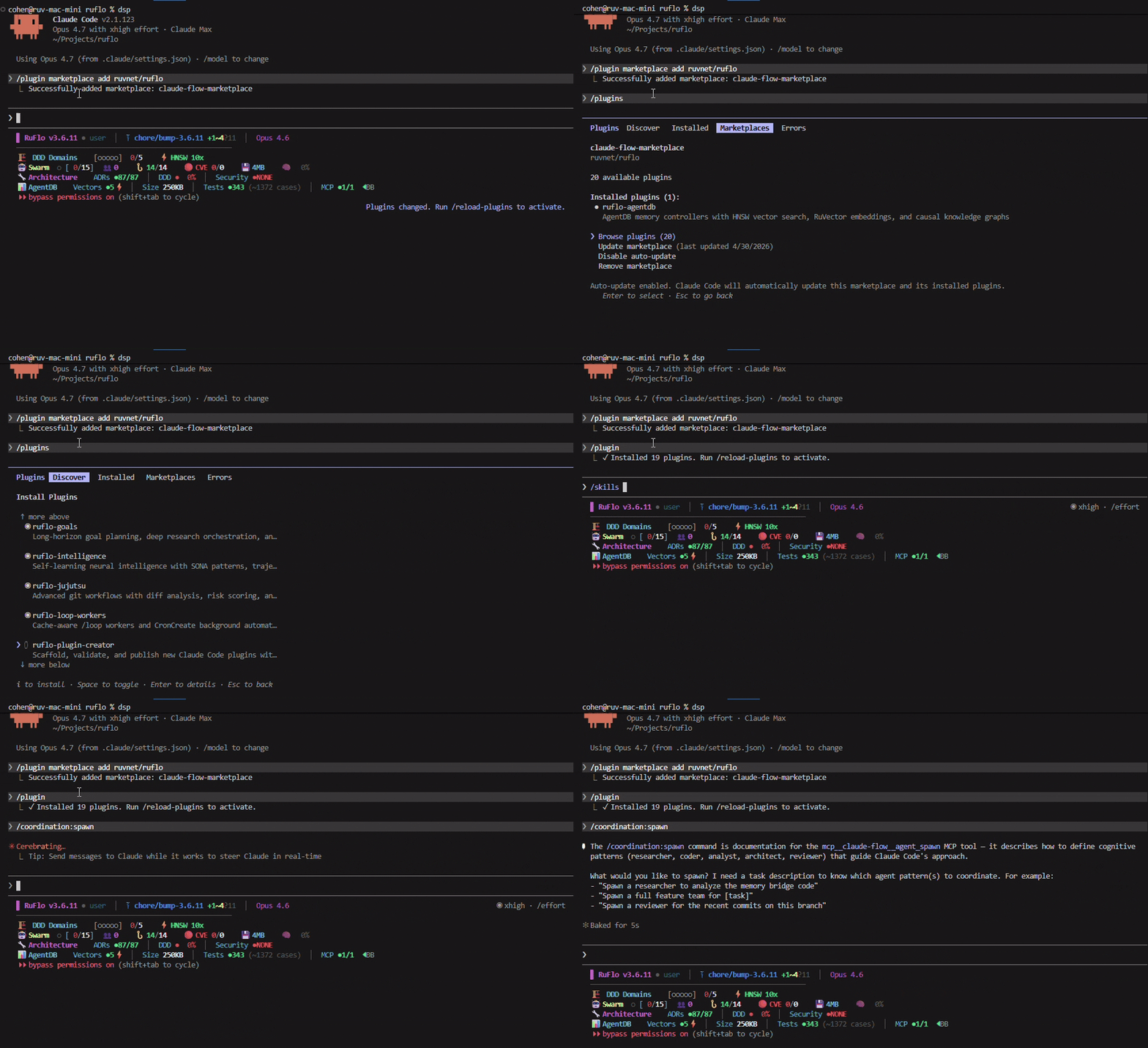
Zero-trust Federation enables secure collaboration with agents on other machines or organizations. It includes enterprise-grade security guardrails such as prompt injection blocking via AIDefence, PII detection, and CVE vulnerability scanning. It supports various LLM providers including Claude, GPT, Gemini, Cohere, and Ollama through smart routing, and also allows for local LLM execution.
The architecture is designed so that Ruflo handles Coordination while developers write code. Unlike traditional approaches, agents do not merely execute; they learn from success patterns (SONA, ReasoningBank) and self-optimize through trajectory learning. It is released under the MIT license and is based on a Rust-based AI engine and the Cognitum.One architecture.
ruvnet/ruflo
🌊 The original agent harness. Deploy intelligent multi-player swarms, coordinate autonomous workflows, and build conversational AI systems. Features adaptive memory, self-learning intelligence, federation, vector RAG integration, and native Claude Code / Codex / Hermes and many more Integrated
TypeScript
This introduction was generated automatically by AI. Check the original for the author's claims and context. Copyright belongs to the original author.
Our guide explains how the AI works. Report errors, attribution issues, or removal requests via Contact.